For district councils
A practical guide for municipalities
IT systems supporting the monitoring of waste collection, with questions and answers
For district councils
Knowledge and experience in implementations
Here we provide you with the knowledge and experience we have gathered since 2001, where we have been implementing XTrack systems at waste collection organisers and operators providing waste transport services.
We believe that conscious and transparent formulation of the terms and conditions of the order, which are based on knowledge about industry standards, guarantees efficient settlement of the procedures, obtaining the most advantageous offers from operators and seamless partnership between the ordering party and the operator and waste producers.
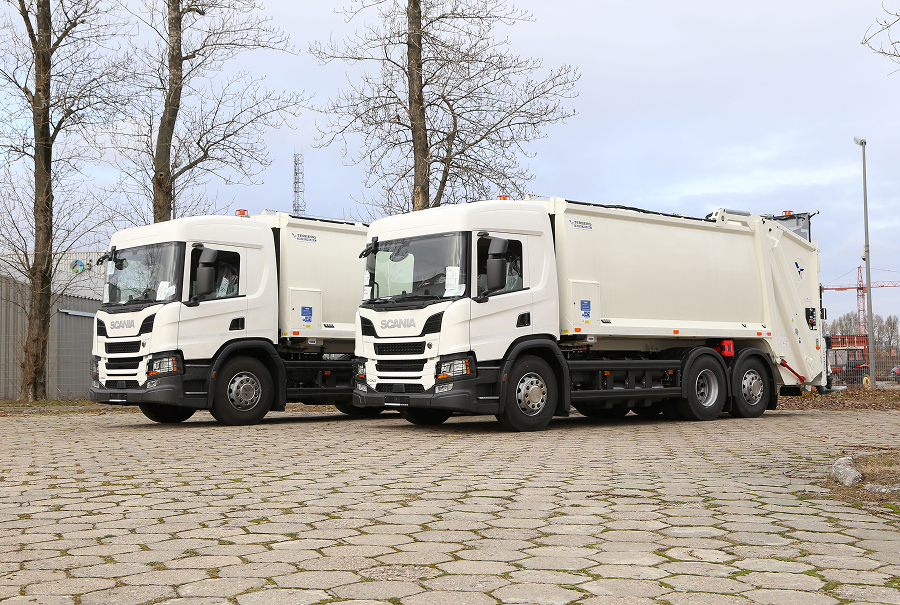
Basic GPS Monitoring
Does GPS monitoring of the vehicle stop location and possible logging of the place of start-up of waste loading mechanisms enable unambiguous confirmation of the collection at a specific waste producer?
No. The location where the vehicle has stopped is different from the location of the property. Waste containers are often brought to the vehicle from several properties at the same time. Such waste collection documented outside the date, time and second of the performed loading can have the assigned address of the vehicle stop, not the place of waste collection/producer.
How can I get an unambiguous confirmation of handling a specific waste collection site?
The solution to this need is the use of an RFID system.
Onboard weighing systems
What is an onboard weighing system?
It consists of scales that can be mounted directly on the vehicle.
Why is the weighing system installed on the vehicle?
To determine the weight of collected waste at the loading location. In the case of scales integrated with the RFID system, to determine the weight of collected waste in the inventoried place of waste collection.
On what types of vehicles can a weighing system be installed?
On dustless waste collection vehicles (garbage trucks), container, box and basket vehicles, including those equipped with a loader crane.
Which weighing systems are recommended, depending on the type of the vehicle?
Because of the number of collection operations on a route (often ranging from 250 to 800) performed by dustless vehicles (garbage trucks) for waste collected from containers between 120 to 1100 L, it is recommended to use a dynamic weighing system. This system ensures measurement resolution from 1 kg, while it does not affect the time of the crew’s work. This means that the operator does not include additional costs in the tender for waste collection that would follow from the higher cost of completing the route as a result of longer work.
For other vehicles, the recommended weighing system is a static weighing system, which is most often installed under the specialist bodywork in the vehicle or on the sling of the loader crane. The static weighing system has a measurement resolution of 10 kg.
If a dustless waste collection vehicle additionally collects oversize waste and/or has a container loading mechanism above 1,100 L, it is possible to simultaneously use dynamic scales on the lifter and static scales under the bodywork.
Can I use the data from an onboard weighing system for settlements with the operator?
Yes. Then it should be indicated in the terms of service provision that the operator is obliged to use traceable scales.
What are the main benefits for the district/city from the use of onboard weighing systems?
It is easy to determine what actual waste weight has been collected in the area by comparing with the weight of waste weighed on the processing installation. This eliminates the situation when waste collected under other agreements is transported in the vehicles. The data from the weighing systems create period statistics not only for the whole route or area, but also for individual waste collection sites, types of containers and fractions provided that this is integrated with an RFID system. The weight of collected waste can be an effective tool for verifying declarations submitted by individual waste producers in terms of the size of the container in use.
RFID Systems
What is an RFID system?
An RFID (Radio-Frequency Identification) system allows marking each container with a unique identifier (tag/chip). During the stocktaking at the location where the container has been placed, the tag can be linked to the data with the name and address of the waste collection location, type of container and fractions of waste collected from it. During each waste collection, dustless vehicles (garbage trucks) read the code stored in the tag with the RFID antennas installed on the lifter. This confirms the collection of waste from a specific waste collection location, regardless of where the vehicle stopped.
Who is responsible for equipping containers with RFID tags if we own the containers as a district/city?
This task may be performed by the waste collection operator or the owner of containers, which may be the district.
What RFID tags should I choose if I own the containers and I want to install the tags on my own?
The requirements, including the installation method, for containers from 120 to 1100 L are described in the EN 18403 standard. According to the recommendations, tags with an operating frequency below 135 kHz should be used. This requirement meets the following “chip” versions available on the market: 125 kHz Unique, 134.2 kHz FDX or 134.2 kHz HDX – all are equivalent and have a 99.9% compliance with the identification systems implemented worldwide on dustless waste collection vehicles. Operating frequency below 135 kHz is called LF RFID.
Who performs stocktaking of the containers belonging to the party ordering waste collection service, which are already in the field and have RFID tags?
This task may be performed by the waste collection operator or the owner of the containers. If the operator assigns the RFID tags to waste collection sites, the ordering party may provide information on the standard of the tags used in description of the contract object. If the stocktaking is carried out by the container owner, they should purchase their own IT system for the inventory, where the results from the stocktaking should be sent to the operator, preferably under the description of the contract object.
Do I need to specify the standard of the required RFID tags in the waste collection tender if it is to be provided by the operator?
There is no need to require a specific standard (125 kHz Unique, 134.2 kHz FDX or 134.2 kHz HDX). It is enough to refer to the industry standard EN 18403. It can happen that the operator already has identification systems on garbage trucks and adapting them to too-detailed requirements in the description of the contract object may be narrow competition. As a result, the operator can include the adjustment to the requirements in the price of the offer for waste collection, which increases the price, while the adjustment itself would have no measurable benefits for the ordering party.
What if in my area under previous agreements, operators left containers and used LF RFID tags with different frequencies? Is it necessary to replace the tags before the next agreement?
There is no need for that. On the market of RFID identification systems, there are suppliers whose systems for garbage trucks can read tags with different frequencies on one route. Inform potential contractors within the description of the contract object what tag standards were previously applied on the containers.
What is the effectiveness of reading LF RFID tags?
The effectiveness is 100%. With full read precision, RFID frequencies below 135 kHz (LF RFID) have a range that guarantees effective reading of container tags, while eliminating random readings at the same time.
Are there other RFID tag frequencies?
Yes. For less than 1% of the implementations of RFID systems on the dustless waste collection vehicles, the UHF frequency (band of approx. 860 MHz) is used. The 860 MHz UHF does not comply with the EN 18403 industry standard. UHF is also characterised by, depending on the type of container, the effectiveness of reading “not less than 90%” or “close to 100%” (according to the descriptions in public proceedings). In addition, UHF is used in labels on clothes or packaging, which, in combination with a large UHF reading range (even a few meters), can cause the reading of containers standing near the vehicle or tags in waste (plastic containers do not block UHF waves). However, due to the large reading area, the RFID technology in UHF can be successfully used in container and box vehicles.
What are the additional benefits for the district/city from the use of identification systems?
RFID (but also barcodes) can support monitoring waste segregation. Since each container collected during stocktaking is assigned to the waste collection/producer location, additional notes and photo documentation clearly assigned to the container increases the effectiveness of monitoring irregularities and handling complaints.
Onboard image recording systems
A system taking photos or recording video?
The state of the current technology and market availability of solutions gives one decisive answer, as the most advantageous solution for the organiser of the waste management system, in terms of documentation for collection, is a video recording system.
An example for a typical solution taking only photos every 3 seconds: at a vehicle speed of 40 km/h, the photo is taken every 33 metres. 3 seconds and 33 meters are sufficient time and distance to make significant events left out, e.g. in terms of settlements with the operator or service of residents.
For video recording, the market standard offers quality from HD (720p) to FHD (1080p), at 1 to 25 frames per second. When taking into account the optimal 8 frames per second, in comparison with a photo recorder, this means that, in a minute, a video recording system generates data equivalent to 480 photographs (8 frames per second multiplied by 60 seconds). This ensures full view into the situation in the field, even at high vehicle speeds.
A hard drive in the vehicle or transmission of recording to the cloud in real time?
The market offers onboard video recording systems and low costs of data transmission over a GSM network with high technical parameters in LTE or 5G. As a result, companies depart from vehicle-installed solutions, which use recording equipment with HDD drives. In those cases, the video is copied only after the end of the route via a cable connection or a WiFi network. It should be borne in mind that solutions with an HDD installed in the vehicle are sensitive to data loss in the event of a failure or disk theft before the data has been copied. The drives have also limited capacity and can overwrite fragments that have not been copied in due time.
The system which sends all online recordings on an ongoing basis is beneficial to the ordering party, as the data is automatically stored in the cloud when the vehicle is still en route and it is available at any time, so complaints can be handled immediately.
Is it true that sending data online and cloud storage generates high costs?
No. Modern image compression methods from digital cameras optimise the amount of data generated. For example, 1 minute of recording material in HD quality at 4 frames per second creates a file with a size of about 470 kB – less than 1 photograph recorded every 3 seconds!
For how long are the recordings stored in the cloud?
Unlike HDD capacity in car recorders, the cloud has no practical capacity limit. Therefore, the period of availability of recordings for analysis may cover the entire term of the agreement with the waste collection operator.
Does the loss of cellular network connection by the system sending all the recordings online lead to data loss?
No. The manufacturers predicted such a situation and equipped the recording modules with an SSD disk that is shock- and temperature-resistant. The video footage is stored on it until the GSM network connection is restored. Then the data in the cloud is automatically updated.
Does the ongoing sending of all recordings to the cloud feature a live view function?
No. The live view function means remote connection (if the vehicle is within the GSM network coverage and it is started) with the recorder in the vehicle over the mobile Internet and preview of the current view from the cameras in the vehicle. The effectiveness of “live view” is limited, as it requires constant attention and it falls to zero in practice if multiple vehicles equipped with several cameras are monitored at the same time.
Do I need an aerial function as a waste collection organiser?
No. It is a function typical of safe reversing systems, which support the driver when manoeuvring large vehicles with limited visibility from the cabin and many blind spots.
What do I need to pay attention to by defining the requirement of a 360 degree view?
The 360 degree view is a popular way of describing safe reversing systems. This means installing wide-angle cameras in the vehicle, thanks to which the driver sees the entire surroundings around the vehicle. It should be noted that the safe reversing systems, in accordance with their intended use, provide an image fully covering the surroundings of the vehicle, but at a distance of less than 3 m from the edge of the vehicle.
From the point of view of the waste collection organiser, it is more favourable that the frame of each camera (typically 4 cameras) includes the surroundings of the vehicle at a distance of more than 3 m, taking into account the horizon line. Only such a configuration ensures insight into the situation in the field during waste collection. The condition of 360 degree view is met with the difference that the hypothetical lines of the field of view of individual cameras can cut at a greater distance from the vehicle than in safe reversing systems. For dustless waste collection vehicles (garbage trucks), the rear camera is a special case as its field of view should primarily cover fully the loading zone (regardless of the number of chambers), including the chute edge.
How can it work optimally with the recordings in my case?
It is worth requiring solutions that integrate video recordings with GPS data. At least with rides and stops and GPS locations in the form of addresses from the map function built into the web app. This allows more efficient search of fragments of recordings, including primarily under addresses or the time of occurrence of an event to be analysed.
The solutions where a full recording must be played with fast-forward function, including using sliders, can significantly hinder searching for the events requiring attention.
Additional documentation of irregularities
How can I document cases that are not logged by the equipment installed in the vehicle?
This is a basic requirement in 99.9% of waste collection procedures. It is usually indicated that the operator can provide photo documentation and notes. In order to improve the transfer and analysis of such materials, it is worth considering the use of dedicated mobile apps operating on smartphones and tablets. This solution has an advantage over photos taken with a camera or smartphone and sent by email, because it allows the sending of documentation online on an ongoing basis from the place of the incident. The current state of the art and market can provide solutions for photo documentation and notes, which are integrated with the GPS monitoring system in the vehicle.
Access to waste collection documentation
What is the best way to access the data?
The web app can be launched in popular web browsers not containing dangerous technologies (such as Adobe Flash or other programs with discontinued support or phasing out support) and without the need to install the software on local computers. This guarantees access to the system on multiple workstations, and if the computers are replaced, the access is not lost and there are no costs connected with software reinstallation.
Do I need to purchase my own software to collect data from the systems on vehicles?
No. As a market standard, the ordering party within the description of the contract object requires direct access to the software related to systems on the vehicles implemented by the operator, together with necessary training on their operation. Usually, such access is carried out with the apps available on a website.
What should I pay attention to when defining the requirements for the software provided by the operator?
The data to be recorded by the systems on vehicles and available in the software to which the ordering party receives access should be defined. Usually, the requirements cannot be changed after the contract has been signed. It is worth describing the result expected by the ordering party, instead of receiving a detailed description of the implementation method.
The data recorded by the systems on vehicles should be transferred to the software made available immediately after recording, with possible delay resulting only from GSM network conditions. If the ordering party is the party handling complaints, it is particularly important that the data is available during the implementation of routes.
In order to standardise data presentation, it is worth considering providing the participants of the procedure with templates of the reports consistent with the ordering party’s needs under the description of the contract object. This may be beneficial for the ordering party and for the quality of the partnership between the parties throughout the contract period. This approach can work particularly well if the performance of waste collection is entrusted to several entities, as each of them can have different systems implemented on their vehicles.
It may be beneficial for the costs and effectiveness of data analysis to require that all data recorded by the systems on vehicles are available under one software package provided by the operator in combination with the reporting standard stated in the description of the contract object.
Do pobrania
Planujesz postępowanie na odbiór odpadów i przygotowujesz opis przedmiotu zamówienia (OPZ)?
Udostępniamy przykładowe dokumenty przetargowe stosowane w polskich samorządach, które mogą stanowić solidną bazę do definiowania wymagań technologicznych i operacyjnych.
Pobierz aktualne OPZ i skorzystaj z doświadczeń rynku.
Want to see how our system works?
We’ll show you our platform in practice, using examples relevant to your industry, processes, and field resources.
Contact